SUSTAINABILITY
Every material used in Bohinc Studio's collections is chosen with longevity, recyclability, or full biodegradability as a primary criterion. This is not a position adopted in response to industry pressure. It is a consequence of how the studio thinks about making: if a piece is not built to outlast the person who buys it, it has not been made well enough.
The studio works across seven materials - steel and brass, marble, solid wood, vegetable-tanned saddlery leather, alpaca wool, and cork. Each has a specific environmental logic, documented here.
Metal
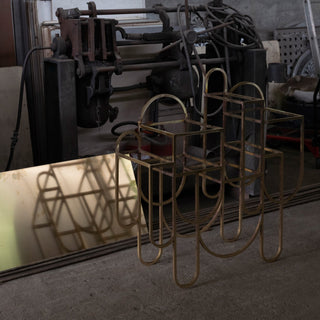
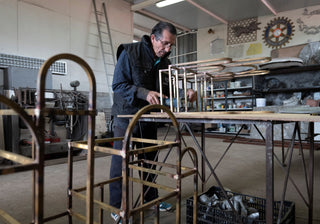
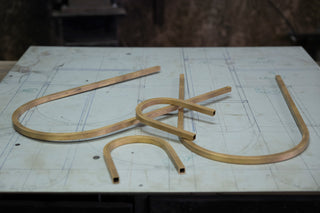
Steel and brass are the most recycled materials on earth. Steel loses none of its structural properties through recycling, it can be melted down and recast indefinitely without degradation, a property that almost no other furniture material shares. Once steel is produced, it does not leave the material cycle: it is either in use or it is feedstock for the next generation of steel. Most of Bohinc Studio's metal pieces are made in specialist workshops in Porto, Portugal, using fabrication techniques - casting, welding, patination that produce no synthetic by-products.
The Orbit, Planetaria, Fortress, and Collision collections are primarily steel. The Haunted Chandelier and Relic Lights commissions are steel and jesmonite. These are pieces designed to last decades, not product cycles.
Saddlery Leather
The Betsy collection uses vegetable-tanned saddlery leather, tanned with plant-derived tannins from bark rather than the chromium compounds used in conventional leather production. Vegetable tanning produces organic rather than metal-contaminated waste, and the resulting leather is more durable, ages better, and develops a richer patina over time. It was traditionally made for harnesses and saddles: objects designed to last decades.
Each piece is handcrafted in Uniqka's Istanbul workshop by Kerem Aris and Merve Parnas. The layering process, individual leather panels applied one by one onto wooden frames, allows off-cuts to be used rather than discarded. Smaller panels that would otherwise be waste fit naturally into the feathering technique, used at edges and transitions. The Betsy collection is available in six colourways: dark brown, powder pink, rust, black, petrol blue, and spice yellow.
Alpaca Wool
The Anima collection is made entirely from natural materials and carries a zero-carbon production footprint. The outer material is pure alpaca wool from Inata, a sustainable French textile brand. Beneath it: Vanadium steel coils, horsehair, and wool - the same internal structure used in traditional upholstery for centuries, with none of the synthetic foam that accounts for most of the environmental impact of contemporary upholstered furniture.
Alpaca wool requires less water and produces less land impact than sheep's wool, and unlike synthetic textiles, it is fully biodegradable. The Anima collection is handmade in London by Maison Phelippeau. Each piece, the sofa, armchair, and occasional chair, is a limited edition of 8 + 2, made to order in 10–12 weeks.
Cork
Cork was chosen for the Utopia public commission, four large-scale installations for the Miami Design District, presented at Art Basel Miami 2023 - for specific material reasons. Cork is harvested from the bark of the cork oak tree without cutting it down; the bark regenerates and is re-harvested every nine to ten years. It is naturally waterproof, making it appropriate for outdoor installation without synthetic sealing. It is biodegradable. And it is native to Portugal, where the pieces were made, eliminating the material transit cost that affects most large-scale sculpture projects.
The forms were shaped using a 5D robotic milling machine in Portugal and finished and painted by hand. The Utopia console, the studio's first indoor piece derived from this body of work, is available through the studio.
Marble and Wood
Marble is a natural stone that requires no synthetic treatment and does not degrade. The Collision, Fallen Empire, and Afternoon Tea collections use marble sourced individually, each slab selected before cutting, which minimises waste from unexpected veining or structural faults. The Fallen Empire collection was produced in collaboration with Serafini's stone workshop in Italy.
The Anima Dark Woods Table uses solid mahogany sourced in Portugal, shaped through a combination of 5D laser cutting and hand-chiselling. Mahogany is a dense, long-grained hardwood that does not warp or split under use. The forms, floating surfaces on rock-like supports, are designed to remain structurally stable over decades. The table is a limited edition of 8 + 2 pieces, made to order.
The studio does not make sustainability claims that rest on certification alone. Every claim on this page corresponds to a specific material decision: the tanning method, the fibre source, the production footprint, the recyclability of the final object. If you have questions about the environmental credentials of a specific piece, write to studio@bohincstudio.com.